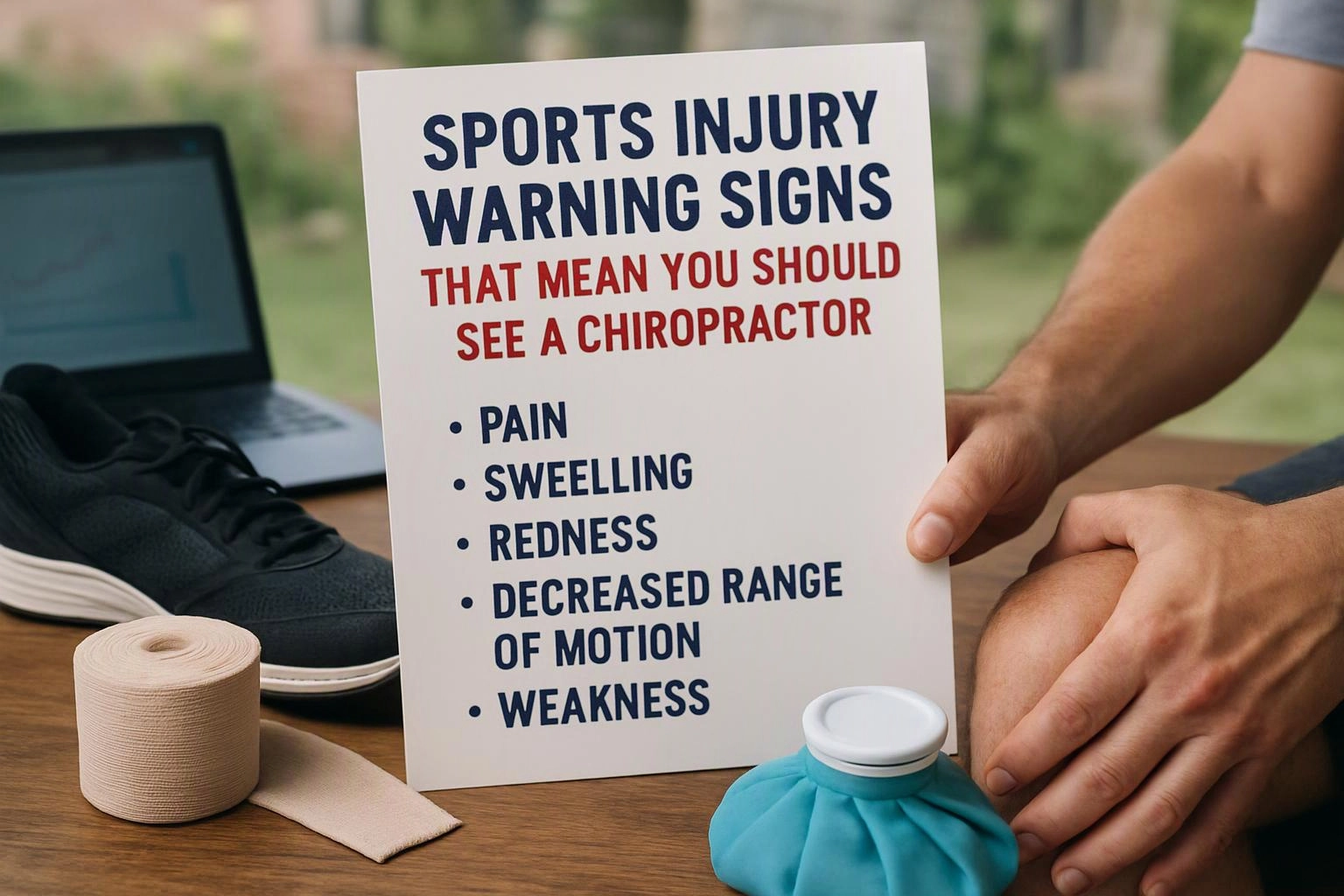
Sports Injury Warning Signs That Mean You Should See a Chiropractor
Sports injury warning signs such as persistent pain, restricted movement, swelling, weakness, or recurring symptoms can mean you should see a chiropractor; Advanced Injury Care Clinic evaluates the injury, identifies movement problems, and recommends appropriate care.
Request an EstimateWhen Should You See a Chiropractor for a Sports Injury?
Chiropractic evaluation is appropriate when a sports injury causes symptoms that persist, limit mobility, or return with activity. Advanced Injury Care Clinic evaluates the injury and guides the next step.
A sports injury can affect a joint, muscle, ligament, tendon, or spine. Our team looks at how the musculoskeletal system is working so we can distinguish a movement problem from an injury that needs medical attention.
Consider an evaluation for pain after exercise, pain during movement, or a movement restriction that changes how you walk, run, lift, or play. We also assess sprains, strains, tendon injuries, ligament injuries, back injuries, neck injuries, shoulder injuries, knee injuries, and ankle injuries.
Warning Signs That Need a Chiropractic Evaluation
Sports injury symptoms that continue or change how you move deserve attention. The following signs can point to a joint, muscle, nerve, or spine problem that we can assess.
Our movement assessment connects your symptoms with joint function, muscle balance, and movement patterns. That information helps us build a recovery plan that matches the injury.
When a Sports Injury Needs Urgent Medical Attention
Urgent medical attention is needed when a sports injury involves a suspected fracture or dislocation, serious head-injury symptoms, sudden neurological changes, or an inability to use the affected body part safely.
Seek urgent care for a suspected fracture, visible deformity, or dislocation. Severe swelling, inability to bear weight, or a sudden loss of normal function also needs prompt medical assessment.
A head injury with concussion symptoms, loss of consciousness, worsening confusion, severe headache, numbness, tingling, or loss of strength requires urgent medical attention. Do not return to play while serious symptoms are present.
After urgent concerns are addressed, our team can help evaluate related movement problems when chiropractic care is appropriate. We do not use chiropractic treatment to replace emergency care for a suspected fracture, dislocation, or serious concussion.
What We Check During a Sports Injury Assessment
Advanced Injury Care Clinic checks the injury history, affected joints and muscles, range of motion, strength, and movement patterns to determine whether chiropractic care is appropriate.
We begin with the injury history, including how the injury happened, when symptoms began, and what activities increase or reduce pain. Our physical examination then reviews joint function, muscle balance, tenderness, and the way the body controls movement.
We may assess spinal alignment when the spine contributes to the symptoms. We also observe pain behavior, movement compensation, and restricted mobility during tasks that relate to your sport.
These findings help us decide whether sports injury treatment should focus on chiropractic care, soft tissue work, corrective exercise therapy, physical therapy, or coordination with another medical service.
DIY Care or Chiropractic Treatment for a Sports Injury?
Self-care may help with a mild, improving sports injury, while Advanced Injury Care Clinic provides evaluation and coordinated treatment when symptoms persist, restrict movement, or return with activity.
Activity modification can reduce irritation while the injury settles. We use the assessment to decide when hands-on care, sports massage, corrective exercise therapy, or physical therapy may support recovery.
| Factor | What you can do yourself | What we do |
|---|---|---|
| Activity | Modify or pause activities that increase pain. | We connect activity limits with your movement findings and treatment plan. |
| Early comfort care | Use rest and ice when they provide comfort and do not worsen symptoms. | We assess whether pain relates to a joint, muscle, soft tissue, or movement problem. |
| Ongoing symptoms | Track pain, swelling, mobility, and changes in function. | We provide sports injury treatment and guide appropriate referrals when needed. |
| Recovery exercises | Avoid exercises that increase pain or cause new symptoms. | We select corrective exercise therapy or physical therapy based on the assessment. |
Self-care is most suitable when symptoms are mild and steadily improving. Persistent pain, limited mobility, swelling, weakness, or recurring symptoms call for an injury assessment.
How Chiropractic Care Supports Sports Injury Recovery
Sports injury treatment supports recovery by addressing joint mobility, soft-tissue function, movement control, and strength through care that may include chiropractic treatment, sports massage, corrective exercise therapy, and physical therapy.
A chiropractic adjustment may support joint movement when the examination shows restricted function. Soft tissue treatment and sports massage may help address muscle tension and changes in tissue movement.
Corrective exercise therapy builds control around an affected joint and helps address muscle imbalance. Physical therapy may be included when rehabilitation needs extend beyond hands-on chiropractic care.
Our goal is mobility restoration with better movement control. We also use movement findings to support injury prevention and reduce factors that may contribute to reinjury.
How to Return to Sports Safely After an Injury
A safe return to sport depends on pain-free movement, functional strength, usable range of motion, and control during sport-related tasks. Our team uses these findings to guide gradual activity progression.
Returning while pain, weakness, or instability remains can increase reinjury risk. We adjust the recovery plan when symptoms return during activity.
What Changes the Cost of Sports Injury Care?
The cost of sports injury care depends on the injury’s complexity, the body areas involved, the assessment required, and the services included in the treatment plan; Advanced Injury Care Clinic explains the care plan and offers .
Injury complexity can change the amount of assessment and care needed. The affected body area, movement limitations, and symptoms involving a joint, muscle, or spine can also shape the treatment plan.
Services such as sports massage, corrective exercise therapy, and physical therapy may affect the overall plan when they are appropriate for the injury. We explain which services are recommended and what each part of the plan addresses.
To obtain an exact quote, contact our team with details about the injury and the symptoms affecting your activity. We can review the assessment needs and explain the available care plan.
How Advanced Injury Care Clinic Helps With Sports Injuries
Advanced Injury Care Clinic provides licensed sports injury care with upfront pricing and combines chiropractic treatment with movement-focused services when the evaluation supports them.
We begin with an injury assessment that connects your symptoms to movement, joint function, muscle balance, and soft tissue performance. Our team then explains the treatment plan in clear terms.
Care may include licensed chiropractic care, sports massage, corrective exercise therapy, or physical therapy when those services match the findings. We focus on mobility restoration, functional strength, return to sport, and reinjury prevention.
When you are ready to discuss a sports injury, contact Advanced Injury Care Clinic for a consultation and an explanation of the next step.
Questions About Sports Injury Warning Signs
Can a chiropractor help with a sports injury?
Yes, Advanced Injury Care Clinic can help with sports injury treatment when the assessment shows a musculoskeletal problem that is appropriate for chiropractic care. We evaluate joint function, muscle balance, mobility, and movement control before recommending treatment.
Should I see a chiropractor for a sprain or strain?
Yes, a sprain or strain can be evaluated by a chiropractor when pain, swelling, weakness, or restricted movement continues. Urgent medical attention is more appropriate when the injury suggests a fracture, dislocation, severe instability, or inability to use the affected body part safely.
Can I see a chiropractor after a concussion?
Yes, you can discuss chiropractic care after a concussion has received appropriate medical assessment and clearance for related care. Loss of consciousness, worsening confusion, severe headache, numbness, tingling, or loss of strength requires urgent medical attention.
Should I stop playing sports when an injury keeps coming back?
Yes, recurring injury symptoms are a reason to pause the activity that triggers them and seek an injury assessment. Continuing through repeated pain can reinforce movement problems and delay a safe return to sport.
What symptoms mean a sports injury may be more serious?
Suspected fracture or dislocation, serious concussion symptoms, loss of consciousness, sudden numbness or tingling, loss of strength, severe swelling, and inability to bear weight can signal a more serious sports injury. These symptoms need urgent medical attention.