
What Is Disc Degeneration?
Disc Degeneration is a gradual change in the spinal discs that can reduce their water content, flexibility, and ability to cushion movement between vertebrae. The process may affect one or more spinal levels and can occur with aging, repeated stress, injury, or other factors. Some people have disc changes without symptoms.
Quick Facts About Disc Degeneration
Category
Spinal disc condition
Used for
Describing disc structure and function
Common confusion
Not identical to a herniated disc
Also called
Degenerative Disc Disease, Intervertebral Disc Degeneration
Often discussed with
Spinal Decompression Therapy
Key Takeaways About Disc Degeneration
- Disc Degeneration affects the disc structure, not only nearby muscles.
- Imaging findings do not always explain a person’s symptoms.
- Disc Degeneration is not the same as a herniated disc.
How Disc Degeneration Works
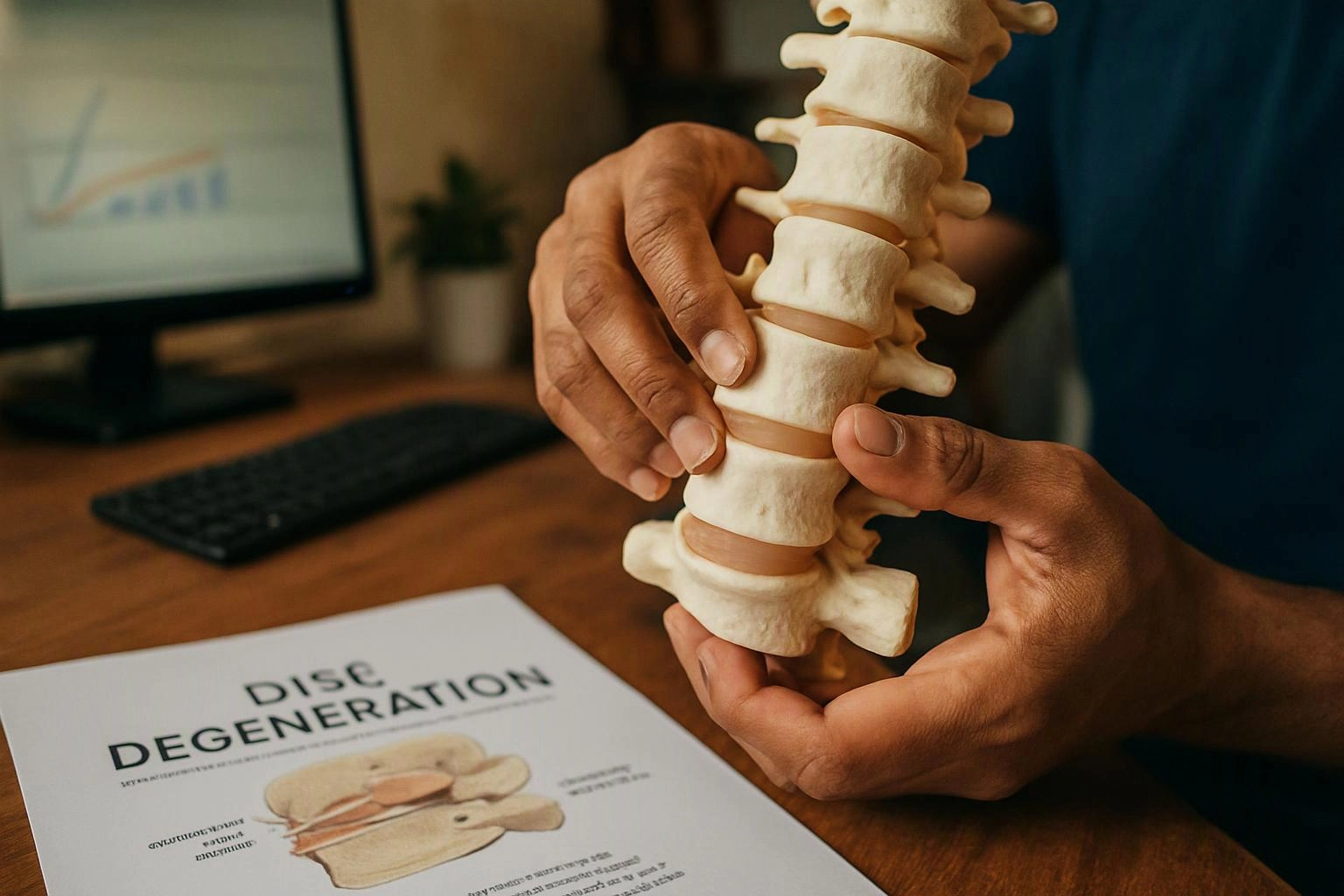
Disc Degeneration changes the structure of a spinal disc, which sits between neighboring vertebrae. The disc has a softer inner area and a tougher outer ring. Changes may affect disc height, flexibility, and how forces move through the nearby spinal segment.
Related glossary terms: Bulging Disc, Herniated Disc, Lumbar Spine.
Clinicians consider symptoms, physical findings, and imaging when they assess these changes. An image may show disc degeneration even when a person has little discomfort. Spinal decompression therapy focuses on controlled changes in spinal loading and positioning, which may be considered as part of a broader care plan when disc-related symptoms are present.
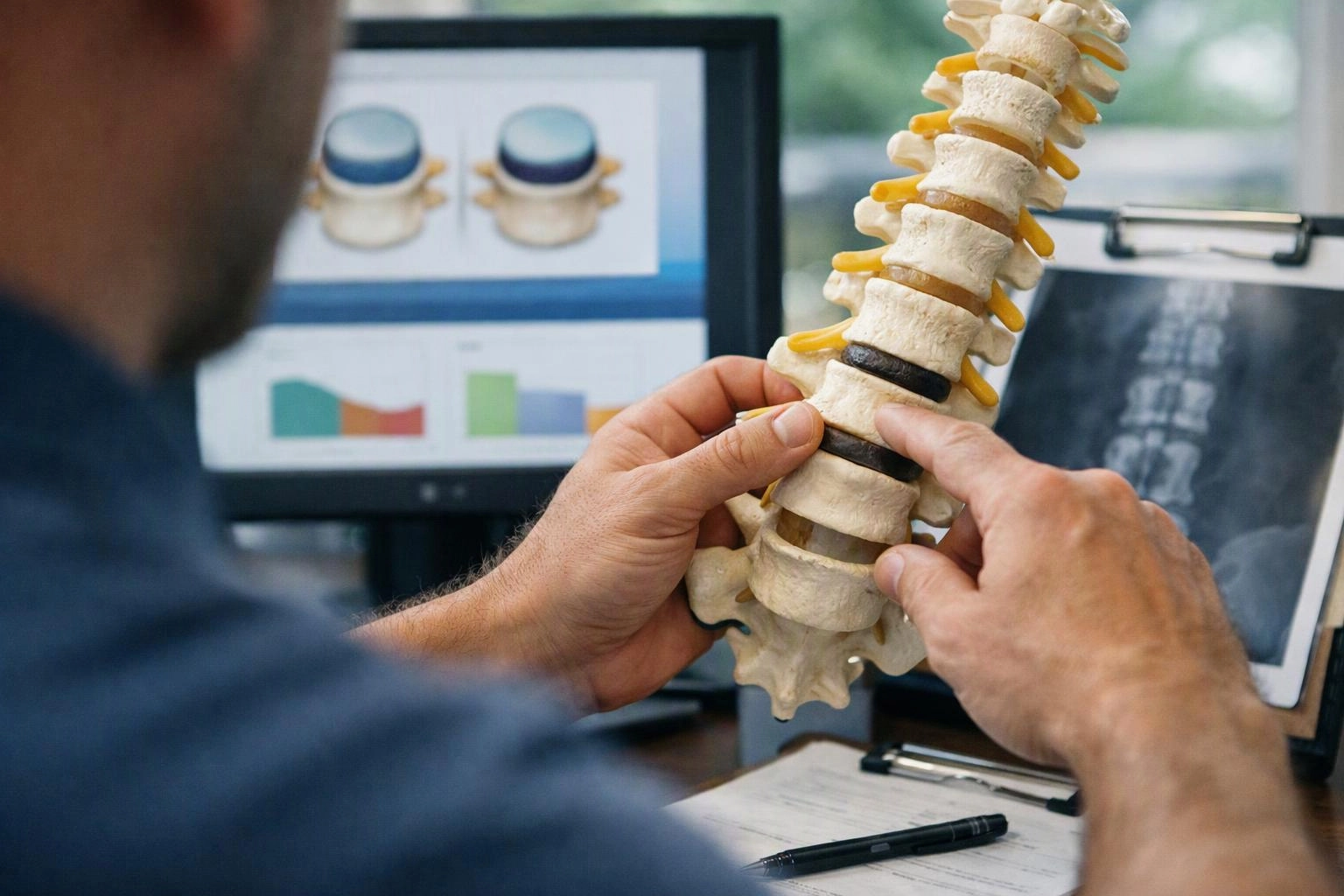
From the Advanced Injury Care Clinic team
When we assess Disc Degeneration, we review the person’s symptoms, movement patterns, and available clinical findings together. We use that information to decide whether Spinal Decompression Therapy fits the care plan. Our team also distinguishes disc changes from conditions such as nerve compression or a herniated disc.
Disc Degeneration in Practice: A Real-World Example
A person with low back discomfort may have imaging that shows Disc Degeneration in the lumbar spine. During Spinal Decompression Therapy planning, the clinician considers that finding alongside movement limits and symptom patterns.
Related Services
Related Terms
Bulging Disc
A bulging disc is a spinal disc that extends beyond its usual boundary as its outer…
Herniated Disc
A herniated disc is a spinal disc injury in which the disc’s inner material pushes through…
Lumbar Spine
Lumbar Spine is the lower section of the vertebral column, located between the thoracic spine and…
Nerve Compression
Nerve Compression is a condition in which pressure on a nerve disrupts normal nerve signaling. The…
Advanced Injury Care Clinic
Have Questions About Disc Degeneration?
Contact Advanced Injury Care Clinic for practical guidance on Disc Degeneration and related chiropractor work in Brentwood.